Access summary:
- Disasters in the U.S. are often treated as sudden “natural” events, but this view hides how people become vulnerable long before a disaster hits them.
- Disabled people are often labeled as a “vulnerable population,” which can make it seem like higher casualties are unavoidable or due to personal limitations.
- In actuality, they are made vulnerable due to the lack of disability-centered disaster prevention, preparation, response, and recovery plans.
- Critical disaster scholars demonstrate that disasters emerge from complex histories of political choices, corporate actions, and intersecting oppressions—not just extreme weather conditions.
- Hurricane Katrina, for example, was made far worse by decades of harmful land development, segregation, and neglected disaster infrastructure.
- When we look at disasters this way, it becomes clear that disabled people are harmed more because their needs are ignored in planning and response.
- Many moments in history could have reduced these harms, but governments and corporations failed to act. To prevent higher casualties, disaster plans must center disabled people and shift responsibility from individuals to the systems that shape risk.
2025 has been called a year of floods—(flash) floods of all sizes hit different parts of the US, including the devastating flash flood in Texas during the July 4th holiday. The year also began with catastrophic wildfires that took over the Los Angeles area. Between January and August, at least 318 people lost their lives and 290 people were injured in weather-related disasters across the country.2 During just the first half of the year, the US endured 15 billion-dollar disasters—each causing more than a billion dollars in damage and totaling $131 billion in losses. Those numbers do not even include the July floods in Texas.3 Whether it is floods, hurricanes, wildfires, tornadoes, or earthquakes, disaster reports typically measure their severity by the lives lost and the cost of destruction. And if such reports care enough about disability communities, they show how disabled people are disproportionately impacted by disasters.4 Disabled people are two to four times more likely to lose their lives in disasters worldwide.5 It is an often-used statistic among disability disaster activists and scholars.
The disabled population is, therefore, designated as a “vulnerable population” in disaster policies and studies. The Centers for Disease Control and Prevention articulates that “Emergencies can happen fast and without any warning. For people with disabilities, emergencies can be especially dangerous.”6 On the one hand, everyone is more or less vulnerable in the face of disasters, while some are particularly so due to the ill-match between their bodies/minds and disasters. For instance, immunocompromised people are particularly vulnerable to wildfire smoke and bad air quality. On the other hand, the more the designation of disabled people as “vulnerable population” comes to be taken for granted, the more I feel the sentiment for society to accept that “it is an unfortunate fate for disabled people to experience higher casualty, because they cannot evacuate quickly or have underlying health conditions.” As such understanding becomes common, surviving disasters is turned into an individual effort and responsibility, and the attribution of higher casualties comes to be misplaced on disabled people and their inability and incapacity to prepare, evacuate, and survive. In many reports of disabled people in disasters, it is implied that the disability and incapacity of disabled people to swiftly evacuate on their own is the bottom-line reason for their higher casualties. It is not uncommon to hear questions like “why didn’t they evacuate earlier?” to blame victims of disasters or sentiments that disasters are “god’s wrath,” as if disaster victims deserve it, or disaster is solely a natural matter and does not warrant governmental relief support and responsibility.7 People rarely notice how disability inclusive disaster risk reduction is nowhere near enough.8
But are the higher and disproportionate casualties among disability communities really inevitable? The answer is NO. Higher casualties of disability communities are NOT an unavoidable or obvious result. I argue that disability communities are MADE vulnerable because of the lack of disability-centered disaster mitigation, preparation, response, and recovery plans and due to environmental injustice that causes intensified and more frequent disasters. There is nothing “natural” about natural disasters. Disasters are socio-politically shaped. We need to shift the responsibility of surviving disasters from individuals to governments and corporations, as governments develop and implement disaster policies and support, and corporations cause the intensifying disasters and also shape the path of disaster support. Thus, we need to engage in an analysis of how intersecting oppressions (such as ableism, racism, transphobia, xenophobia) shape disaster experiences.
I address this myth of “inevitable higher casualties” among disability communities in this and the next blog posts. In this blog, I suggest thinking about disaster differently. Critical disaster studies scholars suggest understanding disasters on a longer time scale, not as an urgent and short-term matter, and as with its own history and birth story.
People generally assume that disasters such as floods begin the moment a high amount of rain hits the ground. As the water level of the river rises and engulfs the lands swiftly, people believe that it is a course of natural order that disabled people who need accessible information, require a longer time to understand the situation, and cannot run fast, climb up to a higher area, or move through water will not make it. In other words, this way of thinking about disaster leads us to internalize “survival of the fittest.”
But what if we understand a seed of disaster to have been planted a long time ago? Thus, it is humans—particularly those with authorities like politicians and corporate executives—who determine who bears the impact of disasters and which land and water is disposable. Historically, they determined which land to develop and determine as habitable, who can live there, what kind of disaster mitigation infrastructure to be laid out, what budget to put aside for disaster preparation and response, whose rescue to be prioritized, and whose voices are reflected in a recovery plan. How are disabled people and their concerns (not) included in the infrastructure?
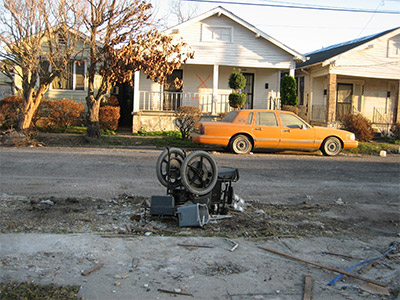
For example, a critical disaster scholar, Horowitz, researched the history of Katrina, the superstorm that landed on New Orleans in 2005.9 Starting the year of 1915, he traced the development of the (wet)land which became the Lower Ninth Ward and neighboring parishes that were disproportionately flooded. He explained how it was a forceful development of marsh and swamp into residential land, offshore oil extraction which causes the sinking shorelines, drawing of canals to cut through the area to offer shortcuts for oil and other commercial shipments, all built up for the flooding and mass casualties of the specific neighborhoods. In other words, it is the politicians’ and corporations’ greed for oil and other businesses and the forceful expansion of residential areas that laid the ground for the disaster. It is also a history of how they ignored the well-being of the land and ocean and overestimated their abilities to drain the water and drill the oil without impacting the land’s integrity which contributed to the historical flood. Their racist practice via real estate determined who gets to live in which neighborhoods and which neighborhoods bear the risks of having canals cutting through them. And the racial and class makeup of different neighborhoods determined the course of flood evacuation, recovery, and compensation. Twenty years after Katrina, the world continues to witness powerful activism led by Black and other racialized communities who were deeply impacted by the floods to seek justice as inequitable relief and recovery efforts made the rich get richer and the poor get poorer.
Imagine—what if the development of the land which became the flood-affected regions had not been led by the greed of politicians and corporations? What if the priority were the well-being of the land, and the focus were not to manage and control but to co-live with the land? What if climate change had never occurred, and a hurricane had never developed so intensely (see the previous blog)? What if the land were never forcibly taken from Chitimacha, Coushatta, Choctaw, and Tunica-Biloxi people (among others) by settlers, and the indigenous way of ensuring the well-being of the land and water continued to be the way of life today? What if disaster prevention, preparation, response, and recovery were planned by centering the needs of those who are most marginalized in society?
It is a lot of “what ifs,” but you get the point. When thinking about disasters over a longer time span, we begin noticing many turning points that could have prevented the mass casualties and damage caused by Katrina. In actuality, this brief recap of the history shows that it is not accurate to say that Katrina alone caused all the damage. It is a long-accumulated disregard for the land and people over profits, which led to the disaster.
As we broaden our understandings of disasters, what becomes obvious is the roles of ableism, racism, and other intersecting oppressions that shape land developments as well as how disabled people’s unique concerns and needs are ignored in the policies and practices of disaster mitigation, prevention, preparation, response, and recovery. This I will address in the next post.
To conclude this post, we must consider the history of how disability communities are made vulnerable to disasters. Turning points to prevent higher casualties among the disabled population exist in history. What if built environments and transportation are accessible and affordable (or free!) with disaster mitigation infrastructure embedded so that disasters rarely impact disabled people’s lives, or they can evacuate with ease? What if disaster preparation were not an individual responsibility but done at the community and government levels? What if health insurance allowed disabled people to have extra medicines and assistive technologies, such as spare wheelchairs, in case of emergency? What if disabled people’s everyday lives are well-supported, so that they have enough money to purchase extra items such as allergy- and disability-friendly foods they need? When we think of disasters in the long term, we start seeing how higher casualties are not inevitable or exclusively caused by nature, but human-caused.
- Otte, Kathleen. (September 4, 2015). No one left behind: Including older adults and people with disabilities in emergency planning. Administration for Community Living. https://acl.gov/news-and-events/acl-blog/no-one-left-behind-including-older-adults-and-people-disabilities ↩︎
- EM-DAT. (2025). Public EM-DAT dataset. https://public.emdat.be/data ↩︎
- Masters, J. (July 16, 2025). U.S. socked with 15 billion-dollar weather disasters during the 1st half of 2025. Tale Climate Connections. https://yaleclimateconnections.org/2025/07/u-s-socked-with-15-billion-dollar-weather-disasters-during-the-1st-half-of-2025/
Gallagher Re. (2025). Natural Catastrophe and Climate Report. chrome-extension://efaidnbmnnnibpcajpcglclefindmkaj/https://www.ajg.com/gallagherre/-/media/files/gallagher/gallagherre/news-and-insights/2025/july/h1-2025-natural-catastrophe-and-climate-report.pdf ↩︎ - I would like to note that such statistics are not perfect and have a space of improvements. It is because some do not include disability as part of demography, or how researchers define disability and who determine one’s disability status are always contested. ↩︎
- United Nations Office for Disaster Risk Reduction. (2023). The world must act on unacceptable failures to protect persons with disabilities from disasters. https://www.undrr.org/report/2023-gobal-survey-report-on-persons-with-disabilities-and-disasters ↩︎
- U.S. Centers for Disease Control and Prevention. (May 2, 2025). Emergency preparedness and disability inclusion. https://www.cdc.gov/disability-emergency-preparedness/about/index.html#:~:text=Past%20experiences%20have%20shown%20that,or%20contribute%20to%20inaccessible%20environments. ↩︎
- Such sentiments are shared, for instance, by Alabama’s then-state senator, Erwin, and New Orleans then-mayor Nagin. WAFF 48. (October 21, 2005). State senator calls Katrina “God’s Wrath.” Waff 48. https://www.waff.com/story/3917509/state-senator-calls-katrina-gods-wrath/; Bustillo, M. (January 17, 2006). Hurricanes may be god’s punishment, mayor says. Los Angeles Times. https://www.latimes.com/archives/la-xpm-2006-jan-17-na-nagin17-story.html; also see, Horowitz, A. (2020). Katrina: A history, 1915-2015. Harvard University Press. ↩︎
- Grech, S., & Weber J. (2025). Disability inclusive disaster risk reduction: laying the terrain. In S. Grech & J. Weber. An introduction to disability inclusive disaster risk reduction: Intersecting terrains. Routledge. ↩︎
- Horowitz, A. (2020). Katrina: A history, 1915-2015. Harvard University Press. ↩︎
 We Survive Together
Leave a comment